Cosmos Flowers

Tall, bushy with large profuse flowers. An old fashion favorite that attracts all the butterflies and hummingbirds

COSMOS PRODUCES COSMIC BEAUTY October 30, 2008

COSMOS PRODUCES COSMIC BEAUTY

How would you like to own a universe? This will probably never happen but you can grow a plant which produces “showy flowers” in an “orderly arrangement of cosmic proportions”. Cosmos is the flower you should grow. Spanish priests grew cosmos in their mission gardens in Mexico. The evenly placed petals led them to christen the flower “Cosmos,” the Greek word for harmony or ordered universe. Cosmos, like many of our warm weather annuals such as marigolds, originated in Mexico and South America. 

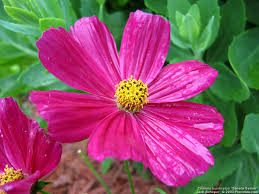
Cosmos belongs to that vast family of plants known as Compositae. Although there are 20 known species of cosmos, two annual species, Cosmos sulphureus and Cosmos bipinnatus, are most familiar to home gardeners. These two species are most easily differentiated by leaf structure and flower color. The leaves of C. sulphureus are long, with narrow lobes and hairy margins. The flower colors of this species are always shades of yellow, orange or red. The C. bipinnatus has leaves that are finely cut into threadlike segments. The foliage looks similar to ferns. The flowers are white or various shades of pink to dark rose.

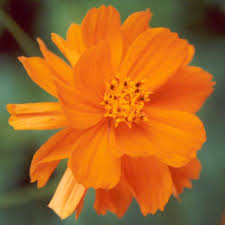
Cosmos sulphureus (Yellow Cosmos) – the species native to the Americas – is my favorite and the one I recommend you try if you have never grown cosmos.. Plants of yellow cosmos can range in height from 4 to 7 feet but the cultivated varieties such as ‘Crest Red’, ‘Ladybird Dwarf Red’, ‘Ladybird Dwarf Gold’, ‘Ladybird Dwarf Orange’, ‘Ladybird Dwarf Lemon’, and Yellow Cosmos – Klondyke Mix are not as tall. The flower heads are composed of disc and ray flowers. The disc, or center flowers are yellow: the ray, or outer petals range from pale yellow or mustard to orange-scarlet. Red is a relatively recent addition to the color range of C. sulphureus. The native species is golden-yellow to orange.

Is C. sulphureus cosmos easy to grow? You bet they are! Here is the cultural information provided by John Thomas of Wildseed Farms who rates C. sulphureus cosmos with an 80 percent planting success: YELLOW COSMOS INFORMATION FROM WILDSEED FARMS 

Rich, fertile soils tend to produce unusually tall, lanky plants. Yellow cosmos requires full sun. Sow seed of C. sulphureus in early spring since seedlings are not winter hardy. The average planting success with this species is 80 percent. The plant height is 2 – 4 feet depending on culture and variety selected. Plants will germinate in 7 – 21 days when the soil temperature is optimum for germination at 70 – 80 degrees F. Plant seed 1/16 inch deep by raking into the soil. C. sulphureus plants bloom from May – November. Plants should be sheared every 30 days or whenever seed pods predominate. Large areas can be seeded at a rate of 15 pounds per acre C. sulphureus plants bloom approximately 50 – 55 days after germination. Yellow cosmos needs to be replanted each spring for continued success.

Yellow cosmos is easy to start from seed. Rich, fertile conditions are not necessary to grow yellow cosmos, but adequate drainage is. The seeds may be sown outdoors after all danger of frost is past and the soil has warmed to at least 65 degrees F. Scatter the seeds right where the yellow cosmos are to be displayed. Firm or rake seeds into a loose soil — if the seed is planted too deep, germination can be affected. Keep the soil moist for 5 – 10 days after seeding. Seeds will germinate in 7 - 21 days. If the early spring has been cold, soil temperatures will remain cool also. If the soil temperature is below 65 F., seeds may not germinate as rapidly. Thinning is really not necessary.

Yellow cosmos is a sun – loving annual; it will not produce as many blooms if grown in the shade. Choose a location that receives at least 8 – 10 hours of direct, sunbathing sunlight. Cosmos will perform best if grown in well-drained soil. Yellow cosmos is not a heavy feeder. Excess fertilization will cause plants to produce excessive leaf growth at the expense of flower production.

Yellow cosmos needs only basic care to provide a colorful abundance of blooms all summer long. After the seedlings emerge, water VERY SPARINGLY. In lieu of any rainfall during an entire month, give the planting bed a long, slow drink. Cosmos is drought tolerant, providing abundant blooms with less water than most other annuals. Herein lies the “problem” which many people encounter when growing cosmos — they “over-care” for their cosmos plants. “Over-care” means too much water, too much fertility and too much shade. When “over-care” occurs, cosmos becomes tall and spindly (even when the new, lower-growing varieties are used), and blooms sparsely. John Thomas says that the best growers of cosmos practice “tough-love” plant culture. “Tough-love” watering means only watering when the cosmos foliage begins to wilt. “Tough-love” fertility means very little if any soil fertility. “Tough-love” location means no shade and in direct, all-day blazing sunlight. Cosmos grows best in the worst conditions Texas has to offer — hot and dry. This is why cosmos is the best possible annual for Texas. When not exposed to “tough-love” growing conditions, this otherwise beautiful flowering plant becomes tall, spindly and sparsely floriferious. Cosmos sulphureus (Yellow Cosmos) is not as sensitive as Cosmos bipinnatus to pampering and “over-care”. However, if you can discipline yourself to do some “tough-love” growing of Cosmos bipinnatus, you can produce the lovely pastels which the ladies really like. Gardeners also have the added advantage of the naturally smaller growing Cosmos bipinnatus varieties such as ‘Gloria’ pink, ‘Tetra Versailles’ red, ‘Candy Stripe’ white with red veins, ‘Day Dream’ white with red halo around yellow stamens, ‘Picotee’ white petals with red margins, ‘Sea Shells’, ‘Dwarf Sensation Mix’ and ‘Psycho White’.

Because cosmos is so easy to grow in the worse conditions spring and summer have to offer, it can be seeded in the spring for early summer bloom or in mid-summer (June) for late summer (August) – until- frost bloom as well. Since cosmos seed actually sprout faster in hot soils and the plant grows best in hot, dry summer temperatures, you can increase your plant population and bloom display by cutting back spring-planted cosmos. When the spring-planted cosmos begins to look as if there are an abundance of dried seed pods, do not remove the plants — encourage re-bloom simply by cutting the plants back to 12 – 18 inches high. They will be back in bloom in a month and the seed cut off will fall to the ground, germinate in the hot soil and increase the density of your plant population and subsequently, the eventual bloom display.

In summary,
THE TOP TEN REASONS EVERYONE SHOULD BE GROWING COSMOS ARE:  

#10 — Cosmos is one of the easiest-to-grow flowers in Texas and is generally a pest-free annual.

# 9 — Cosmos is THE BEST annual for Hot, Dry Locations

# 8 — Cosmos is THE BEST annual for Poor Soils

# 7 — Cosmos is a self-seeding annual

# 6 — Cosmos is an annual which can be direct – seeded into the planting area

# 5 — Cosmos flowers can be used as Cut Flowers
Freshly cut cosmos blooms make a bright airy bouquet. An arrangement of cosmos can last for 7 – 10 days. Select flowers whose petals have just unfolded; they will open fully once cut. Cut the flowers in the morning when their water content is highest and immediately place them in a deep container of tepid water. Before arranging, strip foliage from the lower portion of the stems. If leaves are submerged under water, they will decay quickly, shortening the life of the bouquet.

# 4 — Cosmos flowers are suitable for drying There are many summer flowering annuals which are excellent for drying. Marigold, salvia, cosmos, zinnia, coreopsis and gloriosa daisy are among the most popular and make fine dried specimens. A complete description of how to dry flowers can be found at:
http://aggie-horticulture.tamu.edu/plantanswers/
misc/dryflrs.html 
        

# 3 — Cosmos are suitable for backgrounds and screens
Mid-sized varieties add an airy note when interplanted with evergreen shrubs. Edge a garden path or driveway with medium height cosmos in pastel or bright hues. Because they bloom so freely all summer and into early fall, cosmos is recommended for these highly visible areas.

# 2 — Cosmos attracts birds and butterflies such as (Monarch – Danaus plexippus)

AND, THE NUMBER 1 REASON everyone should grow cosmos is — Growing cosmos is as close as any of us will ever come to actually causing a “cosmic event” but it will be easy for ANY of us to produce showy flowers in an orderly arrangement of cosmic proportions.


Cosmos: dependable beauty – flower gardening October 30, 2008


Cosmos: dependable beauty – flower gardening

THE TRANSLUCENT FLOWERS OF the cosmos, a favorite garden annual for generations, have been a relatively recent discovery for me. I first noticed the rose-hued flowers of Cosmos bipinnatus in rambling country gardens in the mountains of northeastern Georgia. I was captivated by the flowers’ airborne effect; they seemed to float on their tall, gently waving stalks. At dusk the whiteflowered varieties appeared as stars suspended above the feathery foliage and slender stems, which became almost invisible at twilight.

Cosmos is often described as an easy flower for beginners, as almost nothing can go wrong. Worthy types range from the rose, pink and white of C. bipinnatus to the fiery oranges and golds of C. sulphureus, both annuals, and even to the little-known, chocolate-scented black cosmos (C. atrosanguineus), a perennial in Zones 7 through 10. The cosmos is a member of the daisy or composite family, a fact not surprising given the classic daisy form of its flowers.

C. bipinnatus is a tall, sprawling plant, towering from 4 to 6 feet or more. I have grown some problem specimens that billowed taller than 6 feet and were felled by the slightest wind. With a little foresight, however, this problem can be solved by supporting taller varieties with stakes, or more sensibly, by pinching the plants back early in their development to encourage compactness.

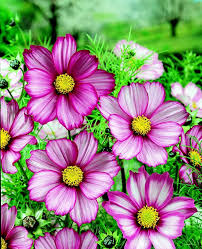
In its most common form, C. bipinnatus has single flowers of rose, pinkish lavender, rich maroon or white. Hybridizers stay busy, however, creating new varieties. ‘Seashells’ is particularly intriguing, with its tubular petals, each flaring into a trumpet shape at the tip. The petals of ‘Candy Stripe’ are vivid white outlined with crimson, giving the look of a Christmas candy cane. ‘Daydream’ produces a misty, almost ethereal effect with its frosty pale-pink petals deepening to rose at the center.

As an added bonus, the three previously mentioned varieties average from 30 to 36 inches in height, making them a good choice for smaller gardens. Gardeners with a very small planting area would do well to try the dwarf cosmos ‘Sonata White.’ Plants of this variety grow only 2 feet in height, bearing snowy white flowers with golden yellow centers.

Evocative of the tropical climate from which it came, Cosmos sulphureus lights up gardens with a bold, bright color scheme that ranges from golden yellow to blazing orange-red. This type of cosmos tends to be sturdier than C. bipinnatus; taller varieties, however, may require support. The smallest hybrids, usually about a foot high, resemble marigolds in the garden. Two of these, ‘Ladybird’ and ‘Sunny Gold,’ are tolerant of dry weather and heat, and produce plenty of semidouble blooms until frost.

The cosmos’s dependability is certainly refreshing. Its large, easy-to-handle seeds may be sown directly in the garden and can almost always be counted on for success, a trait that is true of too few plants. Space the seeds at least an inch apart, as growth is usually quite rapid. Because it needs warm soil to germinate, cosmos should not be sown until well after the last frost of spring. Choose a site with lots of sun and sharply drained soil of average to low fertility. Fertilizers will encourage rich green foliage instead of flowers.

Plant taller varieties of cosmos well to the back of mixed borders. They are effective against walls or railings or planted as a screen. When mixing cosmos with other flowers, it helps to remember that many varieties do not reach their peak until late in the season. Drifts of cosmos mist the background of my garden in early fall, putting out their flowers alongside dahlias and chrysanthemums. Despite its fragile appearance, the cosmos makes an excellent cut flower.

Another characteristic of cosmos — one that some gardeners may consider a drawback — is its ability for rampant self-seeding. I discover seedlings in the most unexpected places, from cracks in the patio to the large compost pile in the woods. Each blossom produces a cluster of about 30 or 40 seeds that are particularly appealing to goldfinches; I often see these lovely little birds feeding on faded cosmos plants in November.

Other winged creatures are drawn to cosmos as well, including butterflies and hummingbirds, which drink nectar from their favorite crimson and maroon varieties. With the departure of the hummingbirds for warmer regions and the first frost, the cosmos season comes to an abrupt end. Discovering this carefree flower has proved a delight for me, and I look forward to its unassuming beauty every summer.

Find Articles                             


Candy Stripe Cosmos October 30, 2008

   Cosmos bipinnatus ‘Candy Stripe’

Bunches of daisy-like flowers and graceful feathery foliage make them a delight in both color and texture. Attactive to birds and butterflies, they are available in two species. Cosmos bipinnatus come in pink, rose, red, white, lavender and bicolors, and Cosmos sulfureus in yellow, orange and scarlet orange. Some varieties of this fast-grower have semi-double flowers, rolled quilled petals or bicolor striped colors. Use 3- to 6-foot tall plants as background, or in wild or naturalistic gardens. Dwarf forms, 1 to 2 feet tall, are good for containers. Excellent cut flowers. Considered drought resistant, Cosmos grows best in full sun, but will grow well and flower earlier in poor, fairly dry soils. Easy to grow from seed, they seed themselves. Do not over-fertilize, unless you want lush plants with few flowers. Tall varieties require stalking. Nearly pest-free, but watch for borers or fungal diseases.

Attributes – Cosmos bipinnatus ‘Candy Stripe’Plant Type: Annual

Bloom Season: Early Summer through Mid Fall

Flower Color: Pink, White

Height: 3 ft. to 4 ft.

Width: 2 ft.

Sunlight: Full Sun

Here is a must visit website SunnyGardens.com

It not only is super packed with information on all types of plants, shrubs and trees, but also has a discussion forum.  Wonderful site!

Notes: Cut Flowers, Long Blooming, Showy Flowers. Susceptible to Aphids, Beetles, Powdery Mildew, Root Rot, Spider Mites.


How to Grow Chocolate Cosmos October 30, 2008

    How to Grow Chocolate Cosmos  

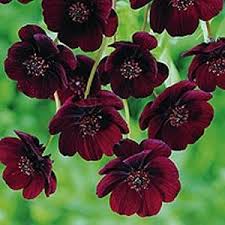
Chocolate cosmos (Cosmos atrosanguinea) is both nose and eye candy for your garden. When it’s in full bloom, mature blossoms on long, slender stems look like candy kisses on a stick and fill the late afternoon with the sweet scent of vanilla tinged chocolate. New blossoms hug the foliage of the plant, nearly concealing it with their numbers! Add to that the sweet chocolate fragrance and you end up with something very special.

Although chocolate cosmos is endangered in the wild, transplants are easily found at most nurseries and garden centers in the spring. However, gardeners who are inexperienced in how to grow chocolate cosmos may overlook what seem to be small, messy tangles of miniature dahlia leaves, unaware that once established, prolific blossoms nearly conceal the foliage. Once in bloom, chocolate cosmos blossoms continuously throughout the summer into the first frosts of autumn.

If you’re planning a gothic garden, chocolate cosmos is the plant for you. Sometimes referred to as black cosmos, dark maroon blossoms are so deep in color that they appear brown/black in late afternoon and evening.

A native of Mexico, the chocolate cosmos is a half-hardy perennial and a sun loving plant that is moderately drought tolerant.

You’ll most easily grow chocolate cosmos from transplants purchased at your local garden center or nursery. Large clumps of established plants can also be divided to provide as many as three or four transplants.

Plant chocolate cosmos in organically rich, well-drained soil in a location that gets full sun. Keep the transplants moist until they established roots and you see the beginnings of some new growth.

In the fall, when foliage dies back, cut plants back to about two inches from the root and over-winter them in a frost-free area. Chocolate cosmos is hardy in zones 7-10. In these zones, you may opt to cover the plants with a cloche to protect them from danger of frost.

You are free to publish the above article in your ezine or website, provided credit in the form of an (HTML clickable) hyperlink is given to the author.

eZine Articles                       


Cosmos Picture Gallery October 30, 2008

      Cosmos Pictures       


Pink/Maroon  Light Purple   Light Pink     White          


 White Pink     White Purple    Orange          Pink                 Purple


Purple White    Yellow            White             Dark Purple   Pink Maroon


Dark Red      Chocolate    Candy Striped       Red


Garden Tools for Cosmos October 30, 2008

Filed under: annuals, cosmos flowers, flower gardening — patoconnor @ 8:55 pm
Tags: , , , , , ,

 Garden Tools for Cosmos 

You will also need a small selection of garden tools for your flower bed.  This is one area that I don’t believe in buying these cheap, flimsy tools.  You save more money in the long run by purchasing tools that are sturdy and of superior quality.

Your tools should include the usual large ones, plus a set of the smaller hand varieties.  I find both come in quite handy and each has a particular use at a particular time.


Garden Tools ~ quality gardening tools are a good investment

Now you can have the benefits of working with garden tools designed for professionals. Heavy duty, high-grade materials used in gardening tools for landscapers, arborists and professional gardeners mean your tools will last longer and perform better.

Good quality garden tools are a wise investment for all gardeners from novices to master gardeners. With proper care and maintenance your garden tools will last a long time, if not a lifetime. Start with the basic gardening tools and build your collection as you gain experience and as your garden grows.

Basic garden tool set:

  • spading fork
  • round-end shovel
  • rake
  • garden shears or pruners
  • hoe

Gardening Trends


Before digging into the garden make sure you have the right tools

Digging around in your garden is not exactly brain surgery, but like surgeons, every gardener should have the right tool for the right job.

Some may say that a shovel is just a shovel, but an expert in Penn State’s College of Agricultural Sciences points out that real gardeners need a spade — and about four other essential gardening implements.

“These days there are catalogs and stores with very specialized equipment, but many gardeners really just need some basic tools,” says J. Robert Nuss, professor of ornamental horticulture. “Once you have a solid set of tools, then you can branch out into specialty equipment.”

Nuss recommends five basic tools:

A long-handled spade. This tool is designed for digging. The blade is straight and set at an angle so it cuts easily into the soil. “A spade is not a shovel,” Nuss explains. “A shovel is designed like a scoop and is used to move material from one place to another.”    

A spading fork. This tool has flat, square tines and is used for moving heavy soil. “Spading forks are invaluable for preparing soil in the spring and harvesting some types of vegetables in the fall,” Nuss says. “Don’t confuse it with a pitchfork, which has rounded, slender tines and is used to move straw or compost.” – see other side    

A steel rake.These large rakes are used to break up clay, to smooth out soil and to rake in fertilizers. “If the garden is large, get a wide, heavy rake,” Nuss says. “It wouldn’t hurt to have a wide leaf rake for lawn work.”

A hoe. Hoes are used to form rows, cover seeds, move soil, cut out weeds and make holes for planting seedlings. “Hoes come in all types and sizes, but most gardeners don’t need heavy ones,” Nuss says. “The most versatile hoes are dual-purpose models, with a triangular cutting head on one side and a cultivating tool with three tines on the other side.”

A hand trowel. Any hand tool that makes gardening more efficient is an invaluable addition to the homeowner’s arsenal of tools. “Hand tools are best for marking rows, weeding, making furrows and moving small plants,” Nuss says.

Nuss says when it comes to gardening, choosing a big tool isn’t necessarily better. “Heavy tools are fine for big people, but if you are short on size or energy, pick smaller tools,” he explains. “The same logic applies to picking the best handle length. Tools are extensions of the body and should be used for extra leverage or reach when pulling or cutting.”  

Nuss advises using heavy-handled tools for moving soil and heavy material. For weeding and cultivation jobs, he recommends using a tool with a lightweight handle.


Old House Web

** I also highly recommend a good pair of garden gloves as well **


Basic Supplies for Growing Cosmos October 30, 2008

  Basic Supplies for Growing Cosmos

Before we get started learning all about growing cosmos, you should know there are a few basic supplies you should have on hand:

1. ) Lots and Lots of cow manure.  You can buy the non-smelly composted bags, 40 lbs worth for a buck at most large gardening supply centers.  I have always found this essential to improve the soil and maintain its health.  It is also important in attracting earthworms, which are vital to a rich, soft soil. 

2.) Miracle grow – or any type of good bloom booster fertilizer.  You won’t believe the number of flowers you will have using these products.  When you read the package look for the numbers 15-30-15 on the front of the package.  The product is easy to use as well.  Simply fill your sprayer canister with the crystals and apply with a water hose.  You will also be able to find store brands or less known brands that are just as good.  Simply be sure of those 15-30-15 readings.

3.) Beer – should be ice cold and refreshing.  No, no….now this isn’t for the slugs.  I have always heard this will atract them and they drown while drinking it.   Now that is a waste of good brew and is reserved for the gardener.

4.) Good, comfy yard chair/lounge.  You’ll need one of these for those rest breaks when you sip your beer and admire your handy work.


When Can I Plant Cosmos October 30, 2008

When Can I Plant Cosmos  


 The central rule of thumb is to plant after the last day of expected frost in your area.  Remember, cosmos are annuals and are frost sensitive.  A few days too early can mean the difference between a beautiful flower garden….and a disaster. 

Planting Zone Map   

Learn what planting zone you live in:

Knowing your planting zone can be very useful when your are planning your garden and flower bed areas.

When you order plants online or through a catalog it is very useful for you to know what will have the best success in your zone. 

Most plants are marked with a zone number. Use this map to know what plants will do best in your zone.


****************************

USDA PLANTING ZONE MAP


Using the Zone Map is really very simple. Find your geographic location on the map. Observe the corresponding color to that location. Look at the map key. That number designates the zone in which you live. 

You should select products that can survive in yourzone. Simply read the item description and you will find a either a zone number or a range of zones. The lower of the the two zone numbers tells you the lowest recommended zone in which that plant can survive. Sometimes, an item will thrive outside that zone area. Remember this is only a guide.

For more information visit:

Indicator Plant Examples Listed by Zone

Plant Hardiness Zones, Details

From: Plant Power

AVERAGE DATES OF FIRST AND LAST FROST
NOTE: The dates below are for the Northern Hemisphere
(Adjust appropriately for Southern Hemisphere)
Zone 1
Average dates Last Frost = 1 Jun / 30 Jun
Average dates First Frost = 1 Jul / 31 Jul Note: Vulnerable to frost 365 days per year

Zone 2
Average dates Last Frost = 1 May / 31 May
Average dates First Frost = 1 Aug / 31 Aug

Zone 3
Average dates Last Frost = 1 May / 31 May
Average dates First Frost = 1 Sep / 30 Sep

Zone 4
Average dates Last Frost = 1 May / 30 May
Average dates First Frost = 1 Sep / 30 Sep

Zone 5
Averagedates Last Frost = 30 Mar / 30 Apr
Average dates First Frost = 30 Sep / 30 Oct

Zone 6
Average dates Last Frost = 30 Mar / 30 Apr
Average dates First Frost = 30 Sep / 30 Oct

Zone 7
Average dates Last Frost = 30 Mar / 30 Apr
Average dates First Frost = 30 Sep / 30 Oct

Zone 8
Average dates Last Frost = 28 Feb / 30 Mar
Average dates First Frost = 30 Oct / 30 Nov

<FONTSIZE=4>Zone 9
Average dates Last Frost = 30 Jan / 28 Feb
Average dates First Frost = 30 Nov / 30 Dec


Zone 10
Average dates Last Frost = 30 Jan or before
Average dates First Frost = 30 Nov / 30 Dec

Zone 11
Free of Frost throughout the year.

Best of the Home                     


Where Can I Buy Cosmos? October 30, 2008

    Where Can I Buy  Cosmos?  

That will depend on whether or not you want to plant seeds or seedlings and the varieties you want to plant.

For such varieties as the tall maroon, pink and white type very often the seed stores (and even dollar stores) will have racks of seed packets 8 or 10 for $1.00.  Now I have used these inexpensive packets for over thirty years with excellent results.

The fancier varieties such as chocolate cosmos, bright lights,  Day Dream, Candy Stripe will require you switch up to some of the better known brand names.

You can also order through various seed catalogs which I will cover in  another page.  I have ordered seeds and plants from these catalogs for over thirty years with excellent success and have received great customer service as well.

You may choose to purchase seedlings, instead of planting seeds.  Usually these are available through any good flower/home and garden center.  You can buy some packets of six flowers or entire flats with dozens of seedlings in them.

Here are some tips on purchasing seedlings:

When starting a new garden, or adding to an existing one,
it is absolutely vital to choose only the healthiest plants from the best sources. While many gardeners prefer the control that can only be had by growing plants directly from seed, others prefer to buy seedlings or seed packs from a reputable nursery or garden center.

When buying seedlings to transplant,
it is essential that the gardener choose only the healthiest and most robust plants. If you are new to the gardening world, be sure to seek advice from more experienced gardeners with regards to the best places to buy healthy plants. Knowing where to buy, and what to look for once you get there, will give you a great start toward gardening success.

Be sure to look over the nursery or garden center
carefully and make an assessment of the health of the plants for sale. Do they have a robust look, with lush foliage and strong stems? Are they free of insects and disease? Be sure to look for any signs of disease, including spots on the leaves, holes, or scarring on the branches or stems.

Each flower variety you buy should come with instructions
for how to best transplant and take care of the plant. If such instructions are not provided, be sure to ask the staff at the nursery for recommendations. Following the recommendations and tailoring your care to the needs of each individual plant is the best way to succeed.

FarFlowers                      


How to Grow Cosmos October 30, 2008

    How to Grow Cosmos  

Annual, Cosmos

If you are a new gardener, Cosmos are a great plant to start with. Fast growing, there is little that can go wrong with this tall growing plant. Cosmos are native to Central America and Mexico. They grow quickly to a height of 4-5 feet. Brightly colored single or double flowers include white, pink, orange,yellow, and scarlet.

Cosmos look great at the back of the garden and in informal arrangements.

Propagation:

Cosmos are grown from large seeds, making them easy to plant. They germinate quickly and never stop from there, normally growing four to five feet in a season.

Sow directly into the garden just before the last frost in your area. Space plants 12 inches apart and thin to 18 inches.

While most Cosmos are annuals, there are perennial varieties. Perennial varieties are Rhizomes and can also be propagated by division.

How to Grow:

Cosmos prefer full sun to partial shade. They will do well in both average and poor soils. They are tolerant dry soil conditions. Add a general purpose fertilizer once or twice a season.

Taller plants mayrequire staking. However, this can be avoided if planted in an area protected from the wind.

Insect and Disease:

Insects and disease problems are very rare for Cosmos. If problems occur, treat early with organic or chemical insect repellents and fungicide.

gardner’s net                                  


Cosmos give you a big bang for your buck. Growing carefree from seed, these annuals (meaning they grow just one year) fill a flowerbed with color and are great cut flowers. Cosmos grow anywhere from 1 foot to 3 feet high, depending on the variety.
 

Instructions

STEP 1: Check out your local garden center in spring for cosmos seeds and seedlings. Because they’re so fast and easy to grow from seed, however, many nurseries don’t carry them as seedlings.

STEP 2: Choose either Cosmos bipinnatus, which has feathery foliage and large daisy-like flowers in all the ranges of white, pink and red, or Cosmos sulphureus, which has smallerflowers in more brilliant, sunset hues and is drought-resistant. (Cosmos also reseed easily.)

STEP 3: Plant indoors four to six weeks before your region’s average last frost date to get earliest bloom. Otherwise, plant outdoors directly in the soil after the last frost date, 8 inches apart in full sun in average soil.

STEP 4: Trim spent blooms to encourage a longer bloom period.

STEP 5: Pull out plants, and discard in fall once frost kills them.

Tips & Warnings

  • Cosmos require moderate to little water.
  • Plant cosmos in groups of at least a dozen to take advantage of their wildflower-like effect.
  • Cosmos don’t thrive in overly rich soil. They’ll produce lots of tall foliage but fewer flowers.

ehow.com